How Slotbound Was Made: The AI Tools Behind a $1.33M Solo Game
Slotbound came out on Steam on November 12. A week later its developer, Min Kim of Optima Arch, announced 200,000 copies sold, and the Steam figures he shared with Inven Global showed $1,332,409 in gross revenue. It is his first game. He made it alone, in about a year, and he says AI wrote virtually all of the code.
Most of the talk since has been about whether that counts. The more useful question for anyone making a game is a practical one: what did he use for each job? He has answered most of it himself, in his Steam disclosure and in interviews.
The stack, job by job
| Job | What Slotbound used |
|---|---|
| Engine | LÖVE, with Lua |
| Code | AI coding agents, on two subscriptions |
| Units and icons | Bought asset packs, with extra pieces drawn by hand |
| Backgrounds, menus, shop screen, VFX | Generative AI, reviewed and reworked by him |
| Sound effects | Stock sounds first, then an AI sound service |
| Music | A composer he met on Reddit |
| Testing | Automated tests on every fix, plus a tool that checks real screenshots pixel by pixel |
Two things stand out.
First, the money. His costs were the AI subscriptions, the asset packs and the Steam fee. He paid for them out of his military service savings.
Second, where his effort went. He did not learn to code. He played every build, wrote rules so the AI would stop repeating mistakes, and shipped more than ten updates in the ten days after launch.
What I had to master wasn't coding syntax, but "how to describe problems accurately" and "how to verify if they were truly fixed."Min Kim, to Inven Global
The part AI did not make
Look at the table again. The characters, the thing players look at for the whole run, came from asset packs.
That was a sound choice. Packs are cheap, consistent and ready today. They also come with limits every developer who has used one knows:
- The pack has 40 units and your design needs 55.
- You need an attack animation the pack does not have.
- Another game on the same store page is using the same knight.
Kim worked around this by drawing the missing pieces by hand. That works when you can draw.
Covering that part with AI
Slotbound was not made with Ludo.ai, and nothing here suggests otherwise. But the row he bought is the row we build for, so here is how the same stack looks when the art is generated too.
- Units. The Sprite Generator makes a character from a prompt or from your own art, in any of 32 art styles, five of them pixel art. A style reference keeps unit 55 looking like unit 1.
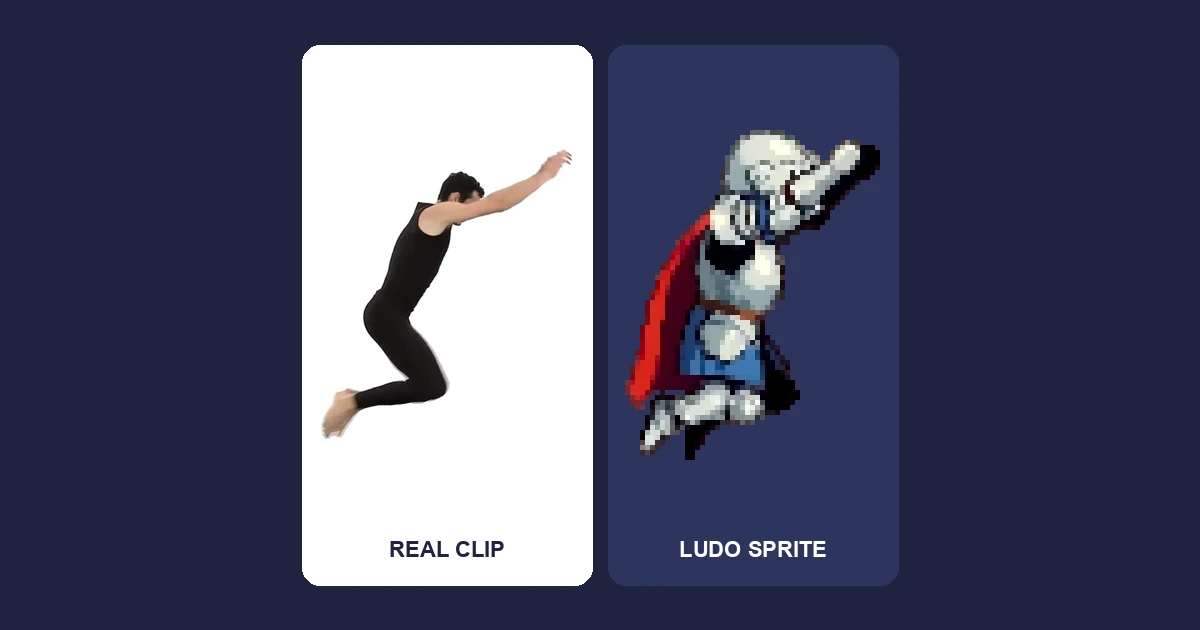
- Animations. The same tool turns a single sprite into a sprite sheet: idle, walk, attack, hit, death. The move a pack is missing takes one generation.
- VFX and backgrounds. Slashes, explosions and pickups from the VFX sprite generator, stage art from the Image Generator.
- Sound and music. Effects and tracks from the Audio Generator.
The part that fits the way Slotbound was built: all of it runs from the terminal. With the ludo CLI, the same coding agent that writes your game can also generate the sprite, slice the sheet and put it in the engine. We tried that on a real project in We Gave Claude Code 5 Days to Finish Our Game, and the job-by-job version is in AI Tools for Indie Game Developers.
What actually sold the game
None of the tools explain 200,000 copies. Kim says his marketing "had almost no effect", and that the game took off when the demo came out. People played a slot machine that summons an army, and told their friends.
His own summary is the one to keep:
AI is just a tool, and the fun and polish of the final product are ultimately the creator's responsibility.Min Kim, to Inven Global
The tools make a one-person game possible. They do not make it good. That is still your job.
Generate the units, animations and effects for your own game.
Try Ludo free